Artist
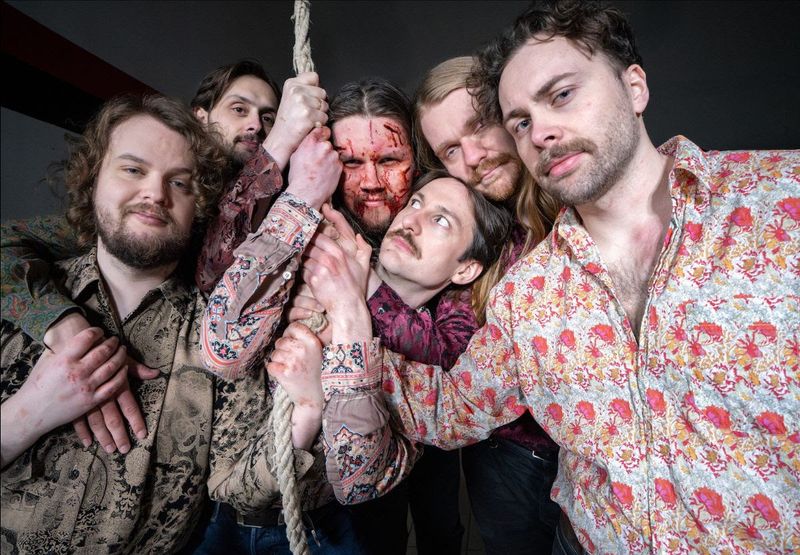
Agabas
Interview Date
February 23, 2026
Interview with Agabas
An interview with Agabas
There are bands that chase heaviness and then there are bands that interrogate it. Agabas have carved out their own volatile corner of extreme music with what they unapologetically call Death Jazz. a collision of blast beats, distortion and what one listener perfectly described as “weaponized saxophone.” It’s a sound that doesn’t feel stitched together for novelty, but forced into existence out of necessity.
Their album Hard Anger doesn’t unfold like a conventional record. It feels like pressure building in a confined space, obsessive, claustrophobic, emotionally raw and defiantly unromantic. Across its runtime, rage, despair, isolation and even strange moments of vastness blur together into something that resists easy catharsis. There are no triumphant releases here. No mythic escapism. Just extreme emotion pushed to its physical limits.
But beneath the distortion and uncompromising weight lies something far more human. Agabas speak about structure and freedom in the same breath, about chaos set in order, about screaming not as performance but as instinct. Their music may sound hostile to the uninitiated, yet for those willing to step inside it, Hard Anger reveals itself as intensely honest, grounded in reality rather than fantasy, driven by feeling rather than image.
For this interview, we wanted to go beyond surface level genre talk and unpack what really fuels Agabas: the mindset behind Death Jazz, the physicality of their sound, the tension between anger and exhaustion, and the evolution of a band that refuses to stay still.
1. Hard Anger feels less like a set of songs and more like a sustained mental state. When you were writing it, did you think in terms of individual tracks at all or was it always one long emotional idea that just happened to fracture into pieces?
A) The album was actually written in a very fragmented manner, all the songs were written as individual tracks in the course of a year or so. But there is of course something that happens when the band gets together to complete the whole thing. Demos turn into actual songs, ideas turn into sounds, feelings turn into expression. And when a process like this takes place intensively in a little cabin in the course of a week, some sort of consolidation is bound to happen. I think this is where the sound of a “sustained mental state” happens, when all our minds work together to combine a set of song demos into something whole.
2. You describe your sound as Death Jazz, which is a term people will try to decode immediately. What does that phrase mean to you internally before anyone else gets hold of it?
A) I once heard someone describe it as “weaponized saxophone”, which I think is the perfect description. Jazz music has always had a heaviness to it, just listen to the stuff people like John Coltrane and Ornette Coleman were doing in the 60’s - it’s super intense. And to us Deathjazz is just our way of channeling this kind of heaviness into another kind of heaviness, the one with breakdowns and blast beats, to create something new. Deathjazz doesn’t have to be anything in particular, doesn't have to be a sound set in stone. All it has to be is a search for a new heavy, whatever that may mean to you.
3. There’s a lot of repetition across the album, but it never feels lazy, it feels obsessive. Is repetition something you use consciously as an emotional tool, or does it emerge naturally during writing?
A) Repetition legitimizes! We like weird stuff obviously, but you can never go wrong with a good hook or a good chorus. We try to make our stuff somewhat accessible in terms of song structure, not because we think more people will listen to it then (we wouldn’t be making deathjazz if that was the goal), but because that’s the kind of stuff we like to listen to. Chaos set in order!
4. Many of the track titles hint at humanity, vulnerability, or connection, yet the music itself feels hostile and closed off. Is that contrast deliberate, or is it just an honest reflection of how those ideas feel to you?
A) Extreme music is the best way to express extreme emotion. People on the outside often only hear anger, but those of us who love this music know that it is so much more. Anger, happiness, ecstasy, frustration, love, hate. When the distortion is cranked to ten you can say so much more. Our songs are about a lot of different things, but the one thing they have in common is that they are not about anything we feel casually about.
5. The album often refuses to “pay off” in the way extreme music usually does. No big release, no triumphant moment. Was denying catharsis important to what Hard Anger is trying to say?
A) I don’t know how deliberate this was, I guess that’s just how we like to write. We like our shit heavy, or at least that’s the direction we wanted for this album, and if there needs some sort of resolution, or “pay off” to soften the blow then it’s not really that heavy anymore.
6. Vocally, nothing feels performative. It sounds more like something breaking than something being delivered. How do you approach vocals as storytelling, physical release, or something closer to documentation?
A) Don’t really think that much about it, we write songs about things that are important to us and then we scream the words like AAAAAAHHH.
7. There’s a strong sense of emotional fatigue running through the record, especially in the second half. Do you see Hard Anger as an angry album, or as an album about what comes after anger?
A) Angry album!! The world is going to shit and we are failing to do anything about it! We need to stop killing each other and start loving each other more.
8. Tracks like “Mørke Daga” and “På åpent hav” feel isolating rather than aggressive. Do you think isolation is more central to this album than rage?
A) The only central theme on the album is extreme emotion. Sometimes that’s anger, sometimes it’s despair, and sometimes it’s the crushing weight of it all, and sometimes, like in the case of “På åpent hav” it’s the mightyness of the sea.
9. Jazz is often associated with freedom and improvisation, yet Hard Anger feels rigid and trapped. How do you balance structure and freedom within the Death Jazz idea?
A) To be free it is necessary to have structure. In jazz, structure comes in the form of chord changes, rhythmic patterns and a certain melodic language, while freedom comes in the form of improvisation and unpredictability within the framework of that structure. In metal, structure looks like verses and choruses, breakdowns and blast beats, the timbre of a distorted downtuned guitar, dissonant and eerie sounds and so on and so forth. Our freedom within this framework is the freedom to blend it with different styles, play around with expectations, and improvisation. All sax solos on the album are improvised, and they sound different every time they’re played live. 10. A lot of extreme music thrives on mythology, imagery, or distance from reality. Hard Anger feels grounded and unromantic. Was it important for this album to stay emotionally honest rather than symbolic?
A) It’s important for us to write about things that we feel strongly about. There’s nothing wrong with writing about dragons and vikings, we just don’t feel very strongly about it. 11. Do you remember a moment during recording or writing where you realised, “This album is becoming something heavier than we expected”?
A) Our sound has definitely gotten heavier and heavier over time. It’s been a lot of fun seeing how far we can push that side of us. The saxophone is a truly aggressive sounding instrument, and it takes a lot physically to push it to that level of distortion which really adds to the primal feel of it. That development has been intentional and something we’ve wanted to do. But for the next one maybe we’ll explore a different side of things, something more beautiful and melodic. Who knows. Whatever feels right.
12. The production feels intentionally exposed almost uncomfortable. Were there moments where you considered cleaning it up, and consciously chose not to?
A) We’ve just really been digging the super distorted sounds lately, there’s so much vibe in it. I think there’s a Decapitator on pretty much every track in the mix. Again, this may change in the future, but right now it’s what we’re fucking with, so that’s what we go for.
13. “Kill” is one of the most unsettling tracks on the record, not because it’s fast or brutal, but because it feels compulsive. What headspace were you in when that track came together?
A) This track was written by Oskar and Johan in about an hour while enjoying some morning coffee and a cinnamon bun, not really much more to it. The sax parts came to be during the studio recording, as well as the lyrics and vocals. We don’t really have a magical process in terms of songwriting, we just try to write as much as possible, and what sticks sticks. The end result will inevitably have a little bit of all of us in it, and for this song in particular that little bit of us was compulsiveness I suppose.
14. The album ends with “The Wizard”, which feels more like a disappearance than a conclusion. Did you always know that track would close the album, or did it earn that place over time?
A) The Wizard was never supposed to be on the album. When we first released Hard Anger last year it was a 10-track album, but then Mascot Records reached out to us and wanted to sign us. After we signed with them, the first thing they wanted to do was re-release Hard Anger as a deluxe version, so we dug up two tracks that didn’t end up on the original release (Mørke daga and KILL), and by this time we had also recorded our cover of The Wizard ( this happened a couple of months after the Hard Anger sessions), and we figured it would be a nice addition to the deluxe version.
15. When people finish listening to Hard Anger, what do you not want them to take away from it?
A) We want people to take away whatever they take away from it. Music is a highly individual experience, and if the thing we make feels like a completely different thing to the person listening than what it felt like to us then that is the truth of their experience. An album can mean a thousand different things to a thousand different people, and I think that’s the beauty of it. 16. Does performing this material live change your relationship with it or does it reinforce the same emotional weight?
A) It’s definitely different! On a studio mix you get to rely on a lot of things to give ultimate impact to the music; a controlled recording environment, mixing tricks, post production, creative cuts and edits. But in the chaos of a live performance everything changes. You’re moving around a lot so the playing gets way more difficult, and often arrangement changes are done to make a song fit the live format better. In this sense it can often feel like you’re playing a completely different song than the one from the album. 17. Looking back now, do you see Hard Anger as a snapshot of who Agabas were at a specific moment, or as something that still feels painfully current?
A) Definitely a snapshot. We’re always evolving. Or at least we’re trying to. Hard Anger is who we were two summers ago when we recorded it. Hopefully we’re somebody else by the next one.
18. If Death Jazz continues to evolve for Agabas, do you see it becoming more abstract, more confrontational, or more introspective, or do you actively avoid thinking that far ahead?
A) That’s the best part, we don’t know yet!