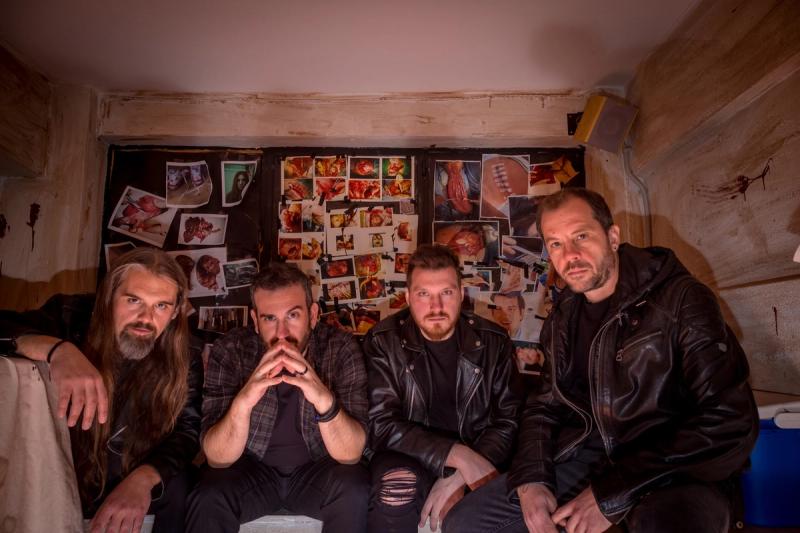
Artist
Dreamlord
Interview Date
February 12, 2026
Interview with Dreamlord
An interview with Dreamlord
Some bands chase trends. Others build worlds. Dreamlord very much sit in the latter category.
There’s a weight to what they do not just in volume or aggression but in atmosphere, intent and the sense that every note serves something larger than itself. Their sound doesn’t simply hit, it looms. It lingers. It pulls you into a space that feels deliberately constructed rather than casually assembled.
With that in mind, we wanted to step beyond the usual surface level questions and dig into the foundations, the mindset, the creative philosophy, and the vision that drives Dreamlord forward. This isn’t about quick promo answers. It’s about understanding the architecture behind the noise.
So here’s what went down when P&L Tunes sat down with Dreamlord.
1. The name Dreamlord carries a strong sense of control and surrender at the same time. What does it actually represent to you as a band?
A) For us, Dreamlord is about that space between control and letting go. It’s about entering a mindset where you stop overthinking and let emotion take over, but without losing awareness. It reflects how we approach music and life in general, trusting instinct while still staying present.
2. Your music feels rooted in atmosphere rather than immediacy. Do you think patience is something modern listeners still have or are you deliberately challenging that?
A) We’re not trying to challenge anyone. This is just how we naturally write. We like music that takes its time, builds tension, and slowly pulls you in. We know attention spans are shorter these days, but we believe there are still listeners who enjoy sinking into an album and letting it unfold.
3. When you’re writing, are you trying to guide the listener somewhere specific, or are you more interested in letting them get lost?
A) We don’t aim for a specific destination. We focus more on creating a mood and letting people experience it in their own way. Everyone connects to music differently, and we like leaving space for personal interpretation.
4. How much of Dreamlord is built on instinct versus deliberate planning and structure?
A) Most ideas start from pure instinct, usually a riff, groove, or atmosphere that just feels right. From there, we shape and structure things more carefully. It’s a mix of spontaneity and discipline.
5. There’s a weight to your sound that doesn’t rely purely on heaviness. Where do you think that weight really comes from?
A) A lot of it comes from emotion, tension, and dynamics rather than just distortion or speed. Sometimes slower, darker passages can hit harder than the fastest or heaviest riffs if the feeling is right.
6. Do you see Dreamlord as an escape, a confrontation, or something that sits uncomfortably between the two?
A) Probably somewhere in between. It can be an escape from everyday noise, but it can also bring out emotions and thoughts you might usually avoid. That balance feels honest to us.
7. How important is visual identity to you, and does it develop alongside the music or after the fact?
A) Visual identity is very important. It usually develops alongside the music, not after. As the songs take shape, the visual ideas start forming naturally, and everything grows together.
8. When a track is finished, how do you personally decide that it’s “complete” rather than just abandoned at the right moment?
A) At some point, you just feel that the song doesn’t need anything more. If adding or removing parts starts making it worse instead of better, that’s when you know it’s done.
9. Does repetition in your music serve a hypnotic purpose, or is it more about reinforcing emotion?
A) It’s both. Repetition helps create a trance-like feel, but it also strengthens the emotion and tension inside a track.
10. Have you ever written something that felt too revealing and if so, did that change how you approached the final version?
A) Yes, and in those cases, we usually try to keep the emotion but present it in a way that feels more universal. The feeling stays honest, but it becomes easier for others to relate to.
11. How do you balance cohesion with the need to evolve, especially when listeners start attaching expectations to your sound?
A) We respect our sound, but we don’t want to repeat ourselves. Evolution happens naturally as our influences and experiences change. We try to move forward without losing our identity.
12. Do you think darkness in music needs to be explained, or should it simply be felt?
A) It should mostly be felt. Overexplaining can take away its power. Music works best when it hits you emotionally, not intellectually.
13. What role does physical space play in your writing, rehearsal rooms, studios, isolation, volume?
A) It plays a big role. Loud rehearsal rooms bring out raw energy, while quiet isolation helps with atmosphere and details. Different spaces push the music in different directions.
14. When listeners say your music feels “immersive,” what do you hope they’re actually experiencing internally?
A) We hope they feel fully absorbed, like they can disconnect from everything else for a while and just live inside the music.
15. Looking ahead, what excites you more: refining what Dreamlord already is, or dismantling it and rebuilding something unfamiliar?
A) Honestly, the mix of both. We like developing our sound, but we’re also excited by the idea of pushing into new territory and surprising ourselves.