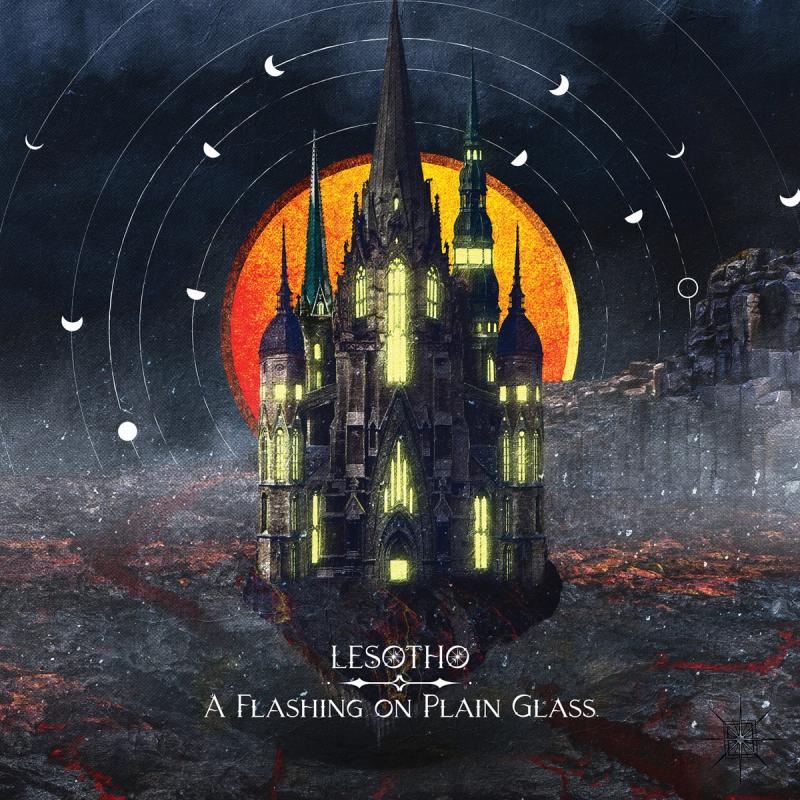
Artist
Lesotho
Release Date
March 13, 2026
Label
Independent
Type
A Flashing On Plain Glass
There’s a certain stillness that hangs over A Flashing On Plain Grass, but it’s not empty or passive. It feels deliberate, like standing in an open field just before the light shifts and everything looks slightly different for a split second. From the outset, Lesotho establish that this record is going to prioritise atmosphere and emotional texture over immediacy. It doesn’t rush, it doesn’t force crescendos for the sake of it, and it doesn’t clutter its arrangements. Instead, it builds patiently, allowing every movement to feel intentional.
What becomes clear early on is the band’s understanding of space. The guitars don’t simply occupy the foreground; they drift in and out of focus. Clean passages shimmer with a faint fragility, often sitting slightly back in the mix so that they feel expansive rather than direct. When distortion enters, it’s not abrasive or chaotic, it’s layered, thickened, and controlled. The heavier sections feel like widening circles in water rather than sudden explosions. That sense of expansion is a recurring motif throughout the album.
The production deserves real credit here. There’s warmth in the low end without it becoming muddy, and the high frequencies carry clarity without harshness. Subtle background textures sit quietly beneath the main melodic lines, adding depth that only becomes fully apparent on repeated listens. You can hear the care in how instruments are placed across the stereo field; nothing feels crowded. Even when multiple layers of guitar are stacked together, they retain separation and purpose.
Dynamically, the album thrives on restraint. Lesotho understand that impact isn’t about volume alone. Many of the record’s most powerful moments arrive not because they’re the loudest, but because they’re the most emotionally charged. A gradual swell, a slight rhythmic push, or a harmonic shift can completely alter the mood of a passage. The band lean into these subtleties rather than chasing obvious climaxes, and it gives the album a more mature, confident feel.
Rhythmically, there’s a quiet precision underpinning everything. The drums don’t dominate; they guide. Patterns are often minimal, allowing the guitars and ambience to carry the emotional weight, but when the percussion steps forward, it does so with purpose. There’s a strong sense of pacing, tempos rarely feel static, even when they technically are. Small variations in emphasis and intensity create forward motion without needing dramatic structural shifts.
Melodically, A Flashing On Plain Grass is rich without being ornate. The lead lines are memorable, but they’re rarely overstated. Instead of obvious hooks, the band opt for motifs that evolve gradually. A phrase might return later in a slightly altered form, carrying a different emotional shade depending on what surrounds it. That evolution keeps the listening experience immersive. It encourages attention.
There’s also an undercurrent of tension running through much of the album. Even in its calmer moments, there’s a subtle sense that something is waiting to surface. It’s not anxiety in a sharp or aggressive sense, more a quiet anticipation. That emotional layering gives the record depth. It feels reflective, but not passive; introspective, but never stagnant.
One of the album’s strongest qualities is how cohesive it feels from beginning to end. The tonal palette remains consistent, yet the band avoid repetition. Each piece adds a slightly different shade to the overall picture. Some moments lean more heavily into fragility, others introduce weight and density, but they all feel like part of the same landscape. The sequencing reinforces that cohesion, creating a flow that feels natural rather than segmented.
There’s a cinematic quality to the writing as well. The music often feels like it’s scoring something unseen, a slow camera pan across open terrain, shifting light, distant movement. That visual quality makes the album immersive. It’s easy to get lost in it, particularly on headphones where the finer production details really come alive.
Technically, the musicianship is strong, but it’s never self indulgent. There are no unnecessary flourishes or moments that feel like they exist purely to showcase ability. Everything serves the mood. That discipline is part of what makes the album so effective. It feels carefully constructed, not improvised or thrown together.
As the record progresses, the emotional weight subtly increases. The layering becomes denser, the harmonic shifts slightly darker, and the atmosphere thicker. Yet even in its more intense passages, Lesotho maintain clarity and balance. They never allow the sound to collapse into noise. Control remains a defining feature throughout.
By the time the album settles into its final moments, there’s a sense of quiet resolution rather than dramatic closure. It feels less like an ending and more like a gradual fading of light, fitting for a record so invested in nuance and atmosphere. A Flashing On Plain Grass doesn’t rely on grand gestures or overt spectacle. Its strength lies in detail, patience, and emotional layering.
Lesotho have crafted a release that rewards time and attention. It’s immersive without being overwhelming, detailed without being cluttered, and emotionally resonant without veering into melodrama. The more you sit with it, the more it reveals subtle textures, dynamic shifts and melodic fragments that linger long after the final note fades.