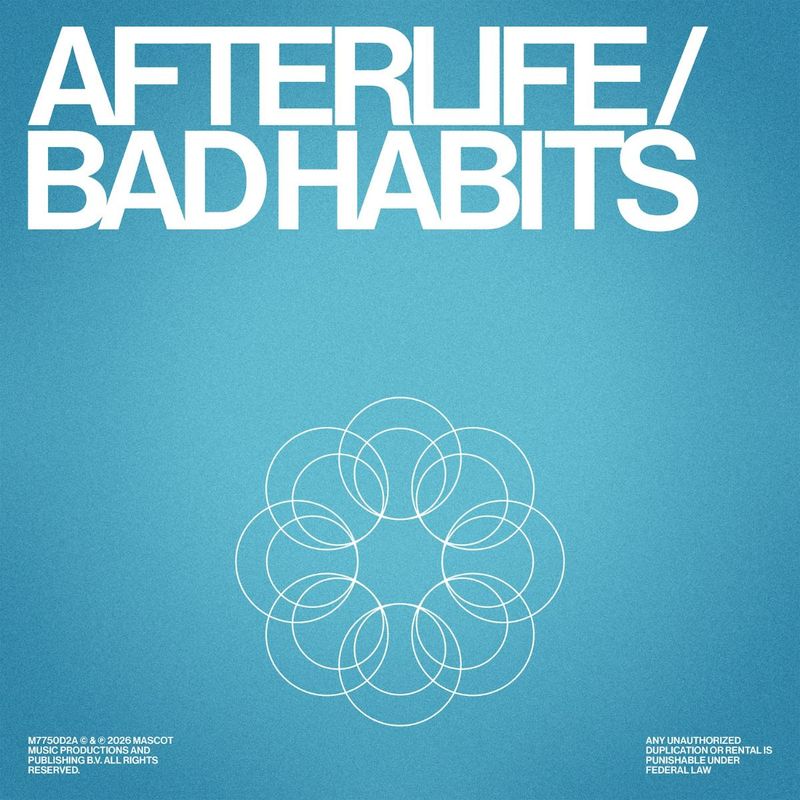
Artist
Afterlife
Release Date
April 15, 2026
Label
Mascot Records
Type
SINGLEBad Habits
Afterlife continue to carve out a space that feels both emotionally raw and sonically calculated with Bad Habits, a single that doesn’t just sit comfortably within modern metalcore conventions but actively stretches them through nuance, control and a deeply introspective core. What becomes immediately apparent across the track is the band’s commitment to atmosphere as much as impact, this isn’t a song that rushes to prove its heaviness, but rather one that allows tension to simmer, build and ultimately rupture in a way that feels earned rather than expected.
The structural pacing of Bad Habits is one of its most defining strengths. Rather than relying on predictable peaks and troughs, the band lean into a more fluid progression where each section feeds organically into the next. The opening moments feel almost suffocating in their restraint, with instrumentation that carries a subtle weight before fully revealing its intensity. This approach creates a sense of anticipation that lingers beneath the surface, making the eventual expansions in sound feel more impactful. When the track does open up, it doesn’t simply explode, it unfolds, layering texture upon texture in a way that maintains clarity while amplifying emotional pressure.
Instrumentally, there’s a strong emphasis on tonal depth and space. The guitars are not just vehicles for aggression but tools for atmosphere, shifting between tight, rhythm driven passages and more expansive, almost cinematic textures. There’s a density to the sound, but it never becomes overwhelming instead, it feels carefully sculpted, allowing each element to occupy its own place within the mix. The bass subtly reinforces this weight, often sitting just beneath the surface but adding a crucial sense of fullness that anchors the track. Meanwhile, the drumming plays a pivotal role in shaping the song’s dynamic identity, precise when it needs to be but also capable of pulling back to let the tension breathe.
Vocally, Bad Habits thrives on contrast but what elevates it is the intentionality behind that contrast. The cleaner vocal lines carry a melancholic clarity that feels almost confessional, drawing the listener into the track’s emotional core. There’s a fragility in these moments that makes them resonate, especially when juxtaposed against the harsher vocal deliveries that follow. The screamed sections aren’t just aggressive for the sake of it, they feel like an emotional overflow, a breaking point where restraint can no longer be maintained. This duality becomes a narrative device in itself, embodying the internal struggle that the song revolves around.
Lyrically, the track explores the cyclical nature of self-destructive behaviour with a level of self awareness that avoids cliché. Bad Habits doesn’t present its themes as abstract ideas instead, it frames them in a way that feels immediate and personal, as though the listener is being pulled directly into the mindset the song inhabits. There’s an underlying tension between recognition and repetition, the understanding that something is harmful, paired with the inability to escape it. This conflict is what drives the song forward, giving it a sense of urgency that extends beyond the instrumentation.
The production plays a crucial role in tying all of these elements together. It strikes a balance between modern clarity and emotional grit, ensuring that every layer is audible without stripping away the rawness that gives the track its impact. The mix allows the quieter moments to feel intimate while giving the heavier sections enough space to hit with full force. There’s a noticeable attention to detail in how transitions are handled, with no abrupt shifts that break immersion, everything feels connected, reinforcing the song’s cohesive identity.
What makes Bad Habits particularly compelling is its ability to maintain engagement without relying on obvious hooks or formulaic structures. Instead, it draws the listener in through its atmosphere and emotional weight, creating a listening experience that feels immersive rather than simply consumable. The track doesn’t demand attention through sheer volume or intensity, it earns it through depth, gradually revealing more layers with each listen.
In a broader sense, this single feels like a statement of intent from Afterlife, a demonstration of growth not just in sound, but in how that sound is used to convey meaning. There’s a maturity in the way the band approach both composition and emotion here, suggesting a clear understanding of their identity and how to evolve it. Bad Habits isn’t just another entry in their catalogue; it’s a refinement of everything they do well, pushed further through deliberate songwriting and a stronger sense of cohesion.
Ultimately, the track leaves a lasting impression not because of any single moment, but because of how those moments connect. It’s the slow build, the controlled release, the interplay between vulnerability and aggression, all working together to create something that feels complete. Bad Habits stands as a deeply considered piece of work, one that doesn’t just hit hard in the moment but lingers long after it ends, inviting repeated listens and continued reflection.