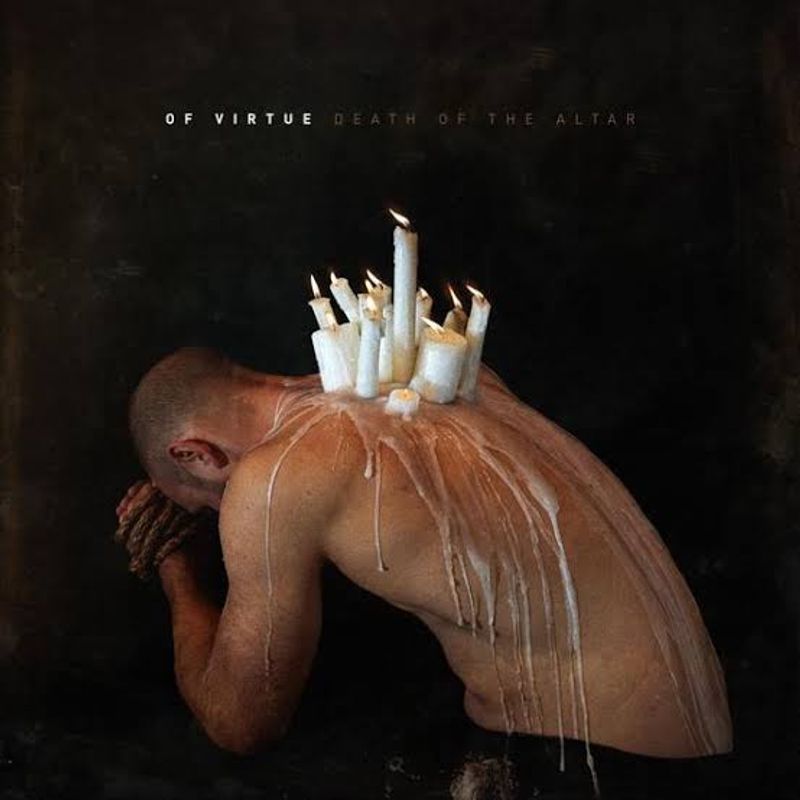
Artist
Of Virtue
Release Date
2 October 2026
Label
Arising Empire
Written By
Phil
Death Of The Altar
There is something about a really good modern metalcore record that comes down to balance. It isn’t necessarily about being the heaviest band in the room, nor is it about having the biggest chorus or the most technically impressive guitar work. It is about knowing when to hit hard, when to pull things back, when to let the melody take over and perhaps most importantly, knowing how to make all of those different pieces feel like they belong together. With Death Of The Altar, Of Virtue have put together a record that understands that balance incredibly well.
Across eleven tracks, Of Virtue take the listener through a mixture of crushing guitars, atmospheric production, electronic touches, soaring melodies and some genuinely aggressive vocal performances. It is a record that sits comfortably within the modern metalcore world but there is enough personality and emotional weight behind what the band are doing to make it feel like more than simply another collection of songs built around breakdowns and big choruses and that’s something that becomes apparent fairly quickly.
The opening title track doesn’t waste any time establishing the world we’re about to enter. Death Of The Altar immediately feels enormous but there is a darkness underneath the production that gives the track more character than simply turning everything up to eleven. The guitars provide the weight, while the atmospheric elements help create a sense of scale around them. Vocally, there is that familiar Of Virtue contrast between clean melody and aggression, and that contrast becomes one of the album’s defining features.
It’s an opening statement that makes sense because it doesn’t try to tell you everything at once. Instead, it gives you a taste of what is coming.
There are huge moments.
There are vulnerable moments.
And there are plenty of moments where those two things collide.
That collision is ultimately what makes Death Of The Altar such an interesting listen.
Divinity continues that momentum with a darker and more confrontational feel. The guitar work has a satisfying amount of weight behind it, while the vocal arrangement allows the song to move between its more melodic sections and the harsher moments without feeling disjointed. It is the sort of track where you can appreciate what Of Virtue are doing from both sides of the fence. If you’re here for the heavier side of the band, there is plenty to get your teeth into. If you’re more interested in the huge melodic hooks, they’re there too.
And rather than making the two sides compete with each other, the band uses one to strengthen the other.
That’s something that becomes increasingly important as the album progresses.
Modern metalcore has reached a point where a lot of bands have access to enormous production, incredibly polished vocal recordings and all of the tools required to make a song sound huge. The difficult part is making that production serve the songwriting rather than becoming the songwriting. Of Virtue largely manage to avoid that trap.
You can hear the production throughout Death Of The Altar, but underneath it there are still songs.
The End is a good example of this. The electronic elements and processed vocals give the track a slightly industrial edge, while the guitars eventually take over and provide the physical weight. There’s a certain cinematic quality to the way the song develops, but it never becomes so focused on atmosphere that the heavier side disappears.
It feels modern without feeling like Of Virtue are chasing modernity simply for the sake of it.
Then comes Enemy State and suddenly the record remembers that sometimes you don’t need to overcomplicate things.
This is where the aggression comes right back to the front.
It’s shorter, more direct and has a sense of urgency that makes it feel almost like a release of everything that has been building around it. The vocal performance carries a real sense of anger, while the guitars give the track enough punch to make it one of those songs that you can immediately imagine translating into the live environment.
And that is something worth mentioning because Death Of The Altar feels like an album that will make considerably more sense once you’re standing in a room full of people experiencing it together.
There are so many sections that feel built for audience participation.
The big vocal hooks.
The heavier transitions.
The moments where everything drops back before coming crashing in again.
Even when the subject matter is deeply personal, there is a communal quality to the way these songs are written.
You can imagine someone hearing a lyric that connects with them and screaming it back at the band with a room full of other people doing exactly the same thing.
What’s It Like To Be Happy? is perhaps where the emotional side of the album becomes particularly difficult to ignore. Even the title feels loaded. It’s not presented as some cheerful question, there is an underlying sense of frustration and distance within it.
That feeling carries through the music.
The song doesn’t need to completely abandon the heavier side of Of Virtue to become emotional. Instead, the band uses the melody, the vocal delivery and the production to create something that feels considerably more personal.
This is where the record starts to feel like it has something to say.
There is a recurring feeling throughout Death Of The Altar of someone questioning what they’ve given themselves to, what they have allowed to control them and whether the things they once believed were worth fighting for are still worth sacrificing themselves over.
That theme makes the album title particularly effective.
An altar represents devotion.
You put something on it because it matters to you.
You sacrifice for it.
You dedicate yourself to it.
But what happens when that devotion becomes destructive?
That question seems to sit underneath a lot of the record, even when the individual songs approach it from different angles.
Too Late continues that feeling, bringing together the melodic and heavier elements of the album in a way that feels increasingly familiar without becoming repetitive. The song has room to breathe but it never loses the momentum that has carried the record this far.
There is also something to be said for the pacing here.
At just over thirty three minutes, Death Of The Altar is not an overly long record and that works in its favour. Of Virtue don’t spend ten minutes trying to make one idea work when three or four would have done the job. The songs generally get in, make their point and move forward.
That makes it incredibly easy to listen to as a complete album.
You don’t find yourself checking how many tracks are left.
You don’t reach a point where you’re wondering when the record is going to get back to the good stuff.
Instead, it keeps moving.
And when Welcome To Hell arrives, the aggression comes back in a particularly satisfying way.
There is something almost confrontational about the track, with the guitars carrying a heavier presence and the vocals adding another layer of intensity. But even here, Of Virtue aren’t interested in making the song completely one dimensional. The melodic elements remain important, giving the track the kind of hook that allows it to stay memorable after the initial heaviness has worn off.
That’s really the trick with this entire record.
The heavy moments are heavy enough to grab your attention.
The melodic moments are memorable enough to keep it.
The Art Of Love then gives the album another opportunity to breathe. It doesn’t feel like a sudden detour or an acoustic interlude thrown in simply because every album supposedly needs one. Instead, it continues the emotional side of what Of Virtue have been building.
There is vulnerability here but it isn’t presented in a way that feels weak.
If anything, it makes the heavier sections elsewhere on the record feel more meaningful.
Because if everything is aggressive all the time, eventually aggression becomes normal.
If everything is huge all the time, eventually huge doesn’t feel huge anymore.
Of Virtue understand that contrast.
Flatline then brings another burst of energy and this is another song where the band’s ability to write memorable vocal moments really comes into its own. There is an immediacy to the track that makes it easy to picture becoming a fan favourite, particularly in a live setting.
It has that quality where you can imagine people who have only heard the song once still finding themselves joining in with the biggest moments.
And that’s an underrated skill.
Writing something technically impressive is one thing.
Writing something that people remember is another.
Of Virtue seem to understand the latter.
By the time Devotion arrives, the album has really settled into its central themes. The title becomes almost a summary of what we’ve been hearing throughout the previous songs.
Devotion can be beautiful.
It can give you purpose.
It can give you something to believe in.
But it can also become dangerous when you lose yourself in it.
That tension gives the song an emotional importance within the album and the longer runtime gives Of Virtue enough room to explore that atmosphere rather than rushing towards the next big moment.
The result is one of those tracks that benefits from being listened to as part of the whole record rather than simply being pulled out as an individual song.
And then everything begins to lead towards Can’t Keep Knockin’ Me Down.
There is something fitting about that title being saved for the closing track.
After everything that has come before, there is finally a sense of resistance.
It doesn’t necessarily feel like the problems have disappeared. It doesn’t feel like the person at the centre of these songs has suddenly figured everything out and walked away completely unscathed.
Instead, there is a feeling of refusing to stay down.
And that is a much more believable conclusion.
Life doesn’t suddenly become perfect because you’ve decided you’re going to fight back.
Sometimes you simply get back up.
Sometimes that’s enough.
Musically, the closer carries that sense of determination while still maintaining the characteristics that have defined the record. The guitars remain weighty, the vocals continue to move between melody and aggression and the production keeps everything sounding appropriately large.
But by this point, you’ve already heard what Of Virtue are capable of.
The final track isn’t there to introduce another side of the band.
It’s there to bring the journey to a close.
And when you step back from the individual songs, that’s where Death Of The Altar becomes particularly successful.
It feels like an album.
That might sound like an obvious thing to say about an album, but it’s surprisingly easy for modern releases to feel like collections of individual singles. Every song is designed to work on its own, every chorus needs to be immediately memorable and every track has to fight for its place in a streaming playlist.
Death Of The Altar does have those individual moments, but the songs also work together.
The heavier sections feel heavier because of the melodic material around them.
The emotional songs feel more vulnerable because the record isn’t afraid to get aggressive.
The production feels bigger because there are quieter moments where it has room to expand.
And the final few tracks feel more meaningful because of everything that came before them.
That’s good sequencing.
That’s good songwriting.
And ultimately, that’s good album construction.
Of Virtue also deserve credit for how accessible they’ve managed to make this record without stripping away its heavier identity.
There are plenty of modern metalcore bands who have gone down the route of becoming increasingly melodic, only to find themselves losing some of the aggression that originally made people pay attention to them.
That isn’t the case here.
There are still riffs that hit hard.
There are still screams that carry genuine anger.
There are still moments that feel designed for the pit.
But there are also choruses that you can imagine being sung by an entire venue.
That combination is probably where Of Virtue are at their strongest.
They understand the importance of making the listener feel something.
And Death Of The Altar is an emotional record, even when it is at its heaviest.
There is anger.
There is frustration.
There is sadness.
There is doubt.
But there is also resilience.
That’s what stops the album from becoming relentlessly bleak.
It may spend a lot of time looking at the things that hurt, but it doesn’t seem interested in staying there forever.
There is always the suggestion that something can change.
Maybe not immediately.
Maybe not easily.
But eventually.
For us, that gives Death Of The Altar a little more depth than its modern metalcore exterior might initially suggest.
Of Virtue haven’t reinvented the genre here, and honestly, that’s not what we think they needed to do.
Instead, they’ve taken the ingredients that have made their music work and put them together with enough confidence to create something that feels cohesive, polished and emotionally genuine.
There will undoubtedly be moments where listeners familiar with modern metalcore will recognise certain production choices or songwriting techniques. That’s unavoidable within a genre that has developed such a defined sound over the last decade.
But familiarity doesn’t automatically equal predictability.
What matters is what a band does with those ingredients.
Of Virtue have made them their own.
Death Of The Altar is a record that can be enjoyed on the surface for what it is: a big, polished, melodic modern metalcore album with plenty of heaviness and plenty of hooks.
But give it a little more attention and there’s considerably more underneath it.
It’s about devotion.
It’s about losing yourself.
It’s about questioning the things you’ve placed on a pedestal.
It’s about recognising when something that once gave you purpose is actually doing more harm than good. eventually, it’s about refusing to keep letting those things knock you down.
That gives the album its identity.
It also makes the title feel much more significant by the time you reach the final song.
Because perhaps the real death of the altar isn’t the destruction of something you once believed in.
Perhaps it’s simply deciding that you no longer need to sacrifice yourself for it.
And that feels like the perfect place for Of Virtue to leave us.
Death Of The Altar isn’t trying to be the record that completely changes metalcore forever.
It’s trying to be a record that connects.
A record that sounds huge through headphones, works in the car, makes sense in a venue and, hopefully, gives someone listening to it a reason to keep going when the words hit a little closer to home.
For us, that’s what makes this record work.
It is heavy when it needs to be.
It is melodic when it needs to be.
It is atmospheric without becoming lost in its own production.
And most importantly, it feels like Of Virtue have something behind the music.
Death Of The Altar is a confident, emotionally charged modern metalcore record that knows exactly what it wants to deliver and for just over thirty three minutes, Of Virtue deliver it without unnecessary distractions.
There may not be a revolutionary new formula hiding inside these eleven tracks.
But there is plenty of heart, plenty of weight and more than enough reason to come back for another listen.
And sometimes, that’s exactly what you want from a record.