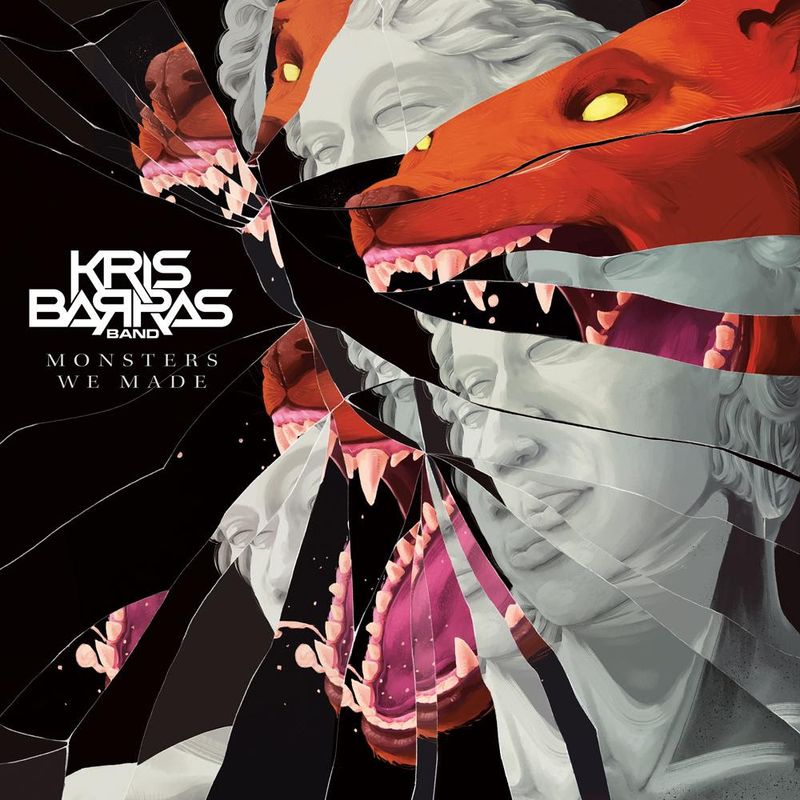
Artist
Kris Barras Band
Release Date
August 14, 2026
Label
Earache Records
Type
Monsters We Made
There is a particular satisfaction in hearing a band arrive at a record that feels comfortable in its own skin. Not necessarily because everything has suddenly become bigger, heavier or more ambitious, but because the musicians finally seem to have found the point where all of their influences, experiences and previous musical decisions make sense together. That is the feeling that sits at the heart of Monsters We Made, the sixth studio album from Kris Barras Band. Released through Earache Records on 14 August 2026, the record finds a band with plenty of history behind them continuing to move forward without appearing particularly interested in abandoning the qualities that brought them here in the first place.
What makes that particularly interesting is the route Kris Barras Band have taken to reach this point. There has always been a strong blues rock foundation beneath their music but their sound has progressively broadened into something considerably more muscular and modern. Halo Effect represented a particularly obvious shift towards heavier territory, and rather than simply following that path further, Monsters We Made feels as though the band have taken stock of everything that worked and everything that didn’t. The result isn’t a record that sounds like it is trying to outdo its predecessor by being relentlessly heavier. Instead, there is a much stronger sense of balance. The riffs can be enormous, the drums can hit with genuine force and the choruses can be huge but there is still room for groove, melody, atmosphere and, perhaps most importantly, vulnerability.
That balance becomes apparent very quickly. Monsters We Made has a sizeable sound, but it doesn’t feel unnecessarily inflated. The guitars carry plenty of weight while retaining enough definition for the character of the playing to come through, and the rhythm section gives everything a physicality that makes the songs feel as though they are constantly pushing forward. There is a confidence to the production that allows the band to sound contemporary without stripping away the rougher edges that make Kris Barras Band recognisable in the first place. The album has clearly been built to work on a large stage, but it never feels as though the musicians have sacrificed their identity simply to make everything sound enormous.
That is where the guitar work becomes particularly important. Kris Barras has always had the ability to bring a blues guitarist’s instinct for phrasing into heavier surroundings, and that remains one of the band’s greatest strengths. There are plenty of riffs here that carry the weight expected from modern hard rock, but they don’t sound like they could have been written by just about any contemporary rock band. There is still movement within them, still a sense of groove and still an appreciation for the spaces between the notes. The heavier tone doesn’t erase the blues influence, it simply gives it a different environment in which to exist.
The partnership between Barras and Josiah J. Manning also gives the guitars a considerable amount of depth. Manning’s role in the production is particularly noticeable in how consistently the album sounds, while the playing itself avoids falling into the trap of turning every guitar moment into a technical demonstration. There are solos, certainly, and there are moments where the musicianship is allowed to take centre stage, but they generally feel like extensions of the songs rather than interruptions. That is an increasingly important quality in rock music. Technical ability is impressive but technical ability that serves the emotional character of a song is considerably more memorable.
Underneath all of that, Frazer Kerslake and Billy Hammett give the album the kind of foundation it needs. The bass isn’t simply there to reinforce the guitar, it helps give the songs their depth, while Hammett’s drumming keeps the record moving without making every track feel as though it needs to race towards the next big moment. There is a noticeable emphasis on groove throughout Monsters We Made and that helps connect the band’s bluesier past with their more contemporary sound. The record can hit hard without becoming stiff and it can settle into a rhythm without losing its sense of momentum.
That rhythmic quality is one of the things that makes the album more enjoyable the longer it plays. On an initial listen, the obvious attraction is the size of the sound and the strength of the choruses, but underneath that are a lot of small decisions that keep the songs moving. The band understand that a heavy riff doesn’t necessarily need to be played at maximum intensity to have impact. Sometimes allowing it to sit back slightly creates considerably more weight when everything eventually opens up again.
That same understanding of restraint carries over into Kris Barras vocal performance. There is plenty of grit and power when the songs demand it, but one of the most effective aspects of his performance is the willingness to pull back. He doesn’t spend the entire record attempting to prove how hard he can sing. Instead, there are moments where the delivery becomes more exposed, allowing the emotion behind the words to come through without the safety net of a huge guitar arrangement.
That becomes particularly important because Monsters We Made is not an album that relies solely on the usual hard rock language of defiance and bravado. There is certainly an element of fighting back throughout the record, but beneath that is a more complicated emotional thread. The album repeatedly circles ideas of isolation, frustration, confrontation, damaged relationships and the consequences of the things we create within ourselves. The title itself suggests something more inward looking than simply another collection of songs about overcoming external obstacles and that gives the record an interesting psychological undertone.
It is not an album that wallows in those ideas, though. Even when the subject matter becomes darker, there is usually a sense of movement. These songs don’t feel trapped inside their own sadness. There is an instinct to push forward, to confront whatever is causing the problem and to keep going. That gives the heavier moments a purpose beyond simply sounding aggressive. The aggression feels like a response to something.
This is also why the more melodic material works so well within the overall record. There are albums where a softer song feels like an interruption, almost as though the band have suddenly remembered that they need a ballad before returning to the heavier material. Monsters We Made is more convincing because the quieter moments feel like part of the same emotional journey. The record needs those moments. Without them, the heavier songs would inevitably begin to lose their impact simply through repetition.
Unspoken is a particularly important part of that equation because it allows the emotional side of the band to come forward without being buried beneath the weight of the instrumentation. Likewise, Otherside provides another change in perspective, creating a more expansive and reflective atmosphere. Those moments give the album breathing room, and that breathing room ultimately makes the heavier material feel heavier. The contrast is what gives the record its shape.
It is a simple principle, but one that plenty of bands forget, if everything is loud, nothing is loud.
Kris Barras Band understand that.
The result is an album that can move from an enormous hard rock passage into something much more intimate without the transition feeling like a change of artist. The underlying identity remains consistent. The same voice, the same guitar character and the same rhythmic sensibility are still there but they are being used differently.
That sense of identity is probably the most impressive thing about Monsters We Made. The album doesn’t sound as though Kris Barras Band are trying to become somebody else.
There are obvious reference points within the broader sound. You can hear the blues-rock background, the modern hard rock influence and the kind of arena sized songwriting that has become increasingly important to the band. But the combination feels specific enough to remain theirs. The guitars have personality, Barras voice has an instantly recognisable roughness and the songs are built around a mixture of groove and melody that keeps them connected to the band’s roots.
It also helps that the band aren’t afraid of writing straightforward rock songs.
There is sometimes a strange pressure within modern heavy music to make everything complicated, unexpected or technically elaborate. Monsters We Made doesn’t fall into that trap. There is nothing wrong with a chorus that simply works. There is nothing wrong with a riff that immediately makes sense. There is nothing wrong with writing a song that people can remember after hearing it once, In fact, that directness is one of the album’s biggest strengths.
The hooks are strong without feeling manufactured, and the choruses have enough melodic lift to make the songs feel naturally anthemic. You can imagine the audience participation before you have even heard the songs live. That doesn’t make them simplistic. It means the songwriting has been stripped down to its most communicative elements.
And that is where the album’s arena ambitions become believable. A record can be produced to sound enormous and still fail to feel like something that belongs in a large room. Monsters We Made has a different quality. The songs have enough space around them to grow when performed live, and the bigger moments feel designed to be shared rather than simply listened to. There is a sense of physical movement in the arrangements, from the way the drums drive the riffs to the way the guitars expand around the choruses.
At the same time, the album doesn’t completely lose the intimacy that has always been part of the band’s appeal. That is a difficult balance to achieve. The further a rock band moves towards arenas, the greater the risk that the music becomes so polished and oversized that the listener feels disconnected from it. Here, the production remains clean and powerful, but there is still enough grit in the performances to remind you that this is a band playing together.
That human quality matters particularly when the album becomes more emotional. Barras doesn’t sound like he is simply delivering lyrics because they are written on a page. There is a sense of lived in experience to the vocals and that gives the more vulnerable material considerably more weight. The record doesn’t need to explain every emotion to you. It gives enough space for the listener to bring their own experiences into it.
There are inevitably, moments where the album’s reliance on established hard rock structures becomes apparent. This isn’t an experimental record and it isn’t trying to dismantle the conventions of the genre. There are familiar rises and falls, familiar approaches to choruses and moments where you can sense where a song is heading before it arrives. For listeners looking for constant surprises, that may limit the album’s impact But that isn’t really what Monsters We Made is trying to achieve. Its strength comes from execution.
The band know the kind of music they want to make and they are increasingly good at making it sound convincing. The riffs have weight, the melodies have staying power, the rhythm section has groove and Barras has developed into a frontman who can carry both the biggest moments and the quieter ones. There is no obvious weak link holding the album back.
More importantly, the songs complement each other. The record doesn’t feel as though it was assembled around a handful of singles with some additional material added afterwards. There is a genuine sense of progression through the eleven tracks. The heavier material establishes the band’s physical presence, the melodic material keeps the record accessible and the more vulnerable songs add emotional depth. By the time the album reaches its closing stages, those different elements feel like parts of the same picture rather than separate experiments.
That cohesion is what ultimately makes Monsters We Made feel like a significant album for Kris Barras Band.
It isn’t necessarily significant because it introduces an entirely new version of the band. In some respects, it does the opposite. It demonstrates that the different versions of Kris Barras Band that have existed over the years can actually coexist. The blues influence doesn’t need to disappear for the band to sound modern. The heavier material doesn’t need to dominate for them to sound powerful. The melodic side doesn’t need to be sacrificed for the riffs to retain their bite. Everything has its place.
That gives the album a maturity that isn’t necessarily obvious on first listen. It is easy to hear the huge guitars and enormous choruses and simply think of Monsters We Made as another big modern hard rock record. Spend more time with it and the balance becomes much more interesting. The band are making choices based on what the songs require rather than what would make the biggest immediate impression.
That is probably why the album feels more confident than desperate.
There is no sense that Kris Barras Band need to prove that they can be heavier than before. They don’t need to prove that they can write an arena chorus. They don’t need to prove that Barras can play guitar. All of those things are already established Instead, the focus is on putting them together in a way that feels natural and that is exactly what Monsters We Made does.
It takes the bluesy instincts that have always existed within the band’s music, adds the weight and production of contemporary hard rock, gives the songs enough melodic identity to stay with you and then allows the emotional material to interrupt the momentum at exactly the moments it needs to. The result is a record that feels substantial without becoming bloated and polished without becoming sterile.
Most importantly, it feels like a record made by a band rather than a collection of performances built around one frontman.
Kris Barras is obviously the central figure, but the album has a strong sense of collective identity. The guitars work together, the rhythm section has a clear role and the production gives every element enough room to contribute. That makes the finished product feel cohesive from beginning to end.
There is a sense throughout Monsters We Made that Kris Barras Band have stopped worrying about which version of themselves they should be.
They can be bluesy.
They can be heavy.
They can be melodic.
They can be vulnerable.
They can be loud enough to fill an arena.
They can also strip everything back and let a song breathe.
None of those things contradict the others anymore.
That is perhaps the biggest achievement of the album.
Monsters We Made doesn’t need to be the band’s most radical record to be one of their most convincing. It simply needs to demonstrate that the years of development have led somewhere, and it does exactly that. The influences are still visible, the heavier experimentation has left its mark and the songwriting has grown into something increasingly assured.
There is a real sense of arrival here.
Not the kind of arrival that suggests the journey is over but the kind that tells you the band finally understand the road they are travelling and for Kris Barras Band, that road leads towards a version of hard rock that is big without being hollow, melodic without losing its bite, rooted in the blues without sounding trapped by it and emotionally open without losing the swagger that has always been part of their identity.
Monsters We Made is, above all else, a record that sounds comfortable with itself.
The guitars have weight.
The songs have hooks.
The vocals have character.
The quieter moments have purpose.
The heavier moments have impact.
Underneath all of it is the unmistakable feeling of a band that has spent years figuring out exactly what it wants to sound like.
There is no need to turn every knob to maximum.
There is no need to chase another identity.
Kris Barras Band have found the space where all of their strengths can exist together, and Monsters We Made is what that space sounds like.