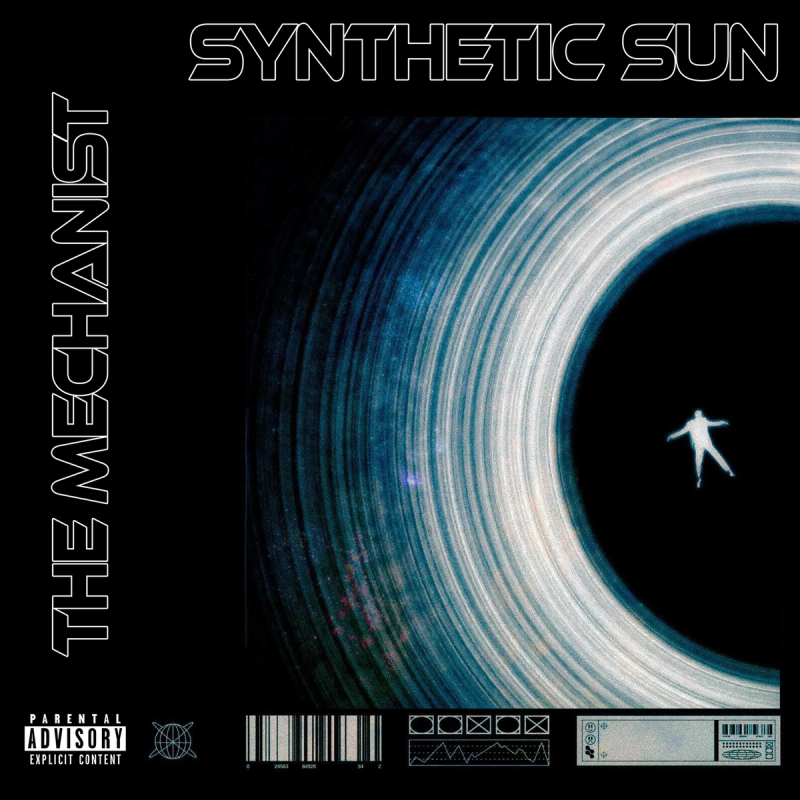
Artist
The Mechanist
Release Date
April 10, 2026
Type
Synthetic Sun
There is a deliberately engineered quality to Synthetic Sun, the latest full length output from The Mechanist, that immediately establishes itself not as a conventional album but as a constructed sonic environment. From the outset, the record presents itself as something rigid, controlled and methodically assembled, where each component feels placed with calculated intent rather than emotional spontaneity. The listening experience unfolds less like a sequence of individual compositions and more like a continuous system in operation, one that draws heavily from industrial frameworks and mechanised sonic architecture. The result is a body of work that prioritises immersion and cohesion over accessibility, placing the listener within a dense, synthetic landscape that feels intentionally isolating and unyielding.
The production across Synthetic Sun plays a central role in defining its identity, operating as both a unifying force and an oppressive presence. Layers of distortion, electronic undercurrents and tightly compressed instrumentation converge into a suffocating mix that rarely offers space for relief, reinforcing the album’s overarching themes of confinement and artificial control. Despite this density, there is a notable level of detail embedded within the mix with subtle textural shifts and buried elements revealing themselves over repeated listens. This approach creates a paradox where the album feels both overwhelming and intricately refined, as though its apparent chaos is underpinned by a strict internal logic. The sonic palette leans heavily into cold, metallic tones, with little warmth present, further amplifying the sense of detachment that permeates the record.
Instrumentally, the album is anchored by precision driven structures that emphasise repetition, weight, and mechanical consistency. The guitar work adopts a heavily processed, almost industrial character, favouring chugging patterns and dissonant intervals that contribute to the album’s hostile atmosphere. Rather than serving as a vehicle for traditional melody, the instrumentation functions as a series of interlocking components, each reinforcing the album’s overarching mechanical aesthetic. The percussion follows a similarly rigid philosophy, often locking into patterns that feel machine-generated in their consistency, yet still retaining enough variation to avoid complete stagnation. This balance between repetition and evolution is key to maintaining the album’s forward momentum, ensuring that while the soundscape remains cohesive, it does not become entirely static.
Vocally, Synthetic Sun continues this trajectory of integration over dominance. The vocal delivery avoids conventional melodic accessibility, instead positioning itself as another layer within the overall sonic framework. Harsh, processed tones blend into the instrumental density, often feeling less like a narrative focal point and more like an extension of the album’s textural design. This approach reinforces the sense that the album is less concerned with individual expression and more focused on constructing a unified, immersive experience. Lyrically, while themes of technological encroachment, dehumanisation and existential decay can be inferred, they are not presented in a direct or overt manner instead, they exist as an undercurrent, communicated through tone and atmosphere rather than explicit storytelling.
What becomes increasingly apparent as the album progresses is its commitment to sustained tension. There is very little in the way of traditional release or catharsis, with the record choosing instead to maintain a near constant state of pressure. This decision contributes to the album’s immersive quality, but also positions it as a demanding listen, one that requires active engagement rather than passive consumption. The pacing is deliberate, with transitions that feel seamless and continuous, further reinforcing the idea that Synthetic Sun is not intended to be dissected into individual moments but experienced as a singular, evolving entity. This structural cohesion is one of the album’s defining strengths, allowing it to maintain a consistent identity from beginning to end.
There is also a notable thematic consistency that runs parallel to the sonic design, with the album presenting a world that feels stripped of organic warmth and dominated by artificial constructs. This is not conveyed through overt narrative exposition, but rather through the cumulative effect of the sound itself. The coldness of the production, the rigidity of the instrumentation, and the integration of electronic elements all contribute to a sense of dehumanisation that feels central to the album’s conceptual framework. It is this alignment between theme and execution that gives Synthetic Sun its sense of purpose, ensuring that every element contributes to the same overarching vision.
Ultimately, what The Mechanist achieve with Synthetic Sun is a fully realised and uncompromising sonic construct. It is an album that does not seek to accommodate or immediately engage, but instead challenges the listener to adapt to its environment. Its strengths lie in its cohesion, its attention to detail, and its unwavering commitment to its aesthetic, resulting in a work that feels both oppressive and meticulously controlled. While it may not offer the immediacy or accessibility that some listeners might expect, it compensates through depth and consistency, rewarding those willing to engage with its layered and methodical design. In this sense, Synthetic Sun stands as a calculated exploration of industrialised sound and thematic immersion, one that prioritises precision and atmosphere above all else and in doing so, carves out a distinctly cold and deliberate identity.