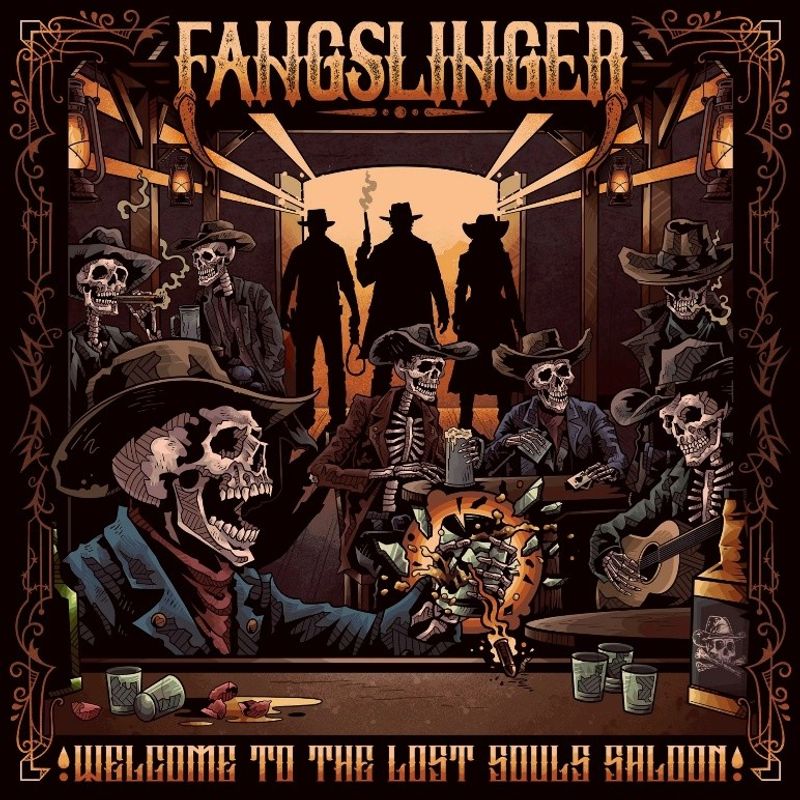
Artist
Fangslinger
Release Date
April 24, 2026
Type
The Lost Souls Saloon
From the moment Welcome To The Lost Souls Saloon begins, Fangslinger don’t ease you in, they position you. There’s an immediate sense that you’ve stepped into something already in motion, a world that doesn’t need to explain itself because it exists so fully in its own identity. The atmosphere isn’t just present, it’s suffocating in the best possible way, thick with tension, dust, and something far more sinister lurking beneath the surface. This is an album that understands the power of immersion, and more importantly, trusts the listener enough to let that immersion unfold gradually rather than forcing it.
What becomes striking almost instantly is the band’s control over pacing and space. There’s a deliberate restraint in how the record reveals itself, it doesn’t rush toward impact, it builds toward inevitability. The early movements feel expansive, almost cinematic in their construction, allowing the sonic landscape to stretch outward before tightening its grip. You can feel the world forming around you not just sonically but emotionally as layers of tension, melody and texture begin to interlock with a precision that never feels mechanical.
As the album progresses, that sense of control shifts into something more aggressive, but never chaotic. The weight increases, the edges sharpen, and yet everything remains intentional. The guitars carry a biting presence, but they’re never overbearing, the rhythm section anchors everything with a grounded force that gives the album its sense of movement and the vocals sit at the centre of it all with a delivery that feels less like performance and more like narration from within the world itself. There’s a subtle theatricality here, but it never crosses into excess, it serves the atmosphere rather than distracting from it.
One of the most compelling aspects of the record is how it balances heaviness with texture. It would be easy for an album built on this kind of dark, gothic western aesthetic to lean too heavily into density but Fangslinger avoid that entirely. Instead, they allow moments of space, groove and even unexpected fluidity to emerge, giving the album a dynamic range that keeps it constantly engaging. There are passages that feel almost hypnotic in their movement not because they’re repetitive, but because they draw you in through subtle shifts in tone and layering that reveal more with each listen.
There’s also a strong sense of evolution running throughout. The album never feels static, it moves, breathes and transforms as it unfolds. Themes are introduced, expanded upon and recontextualised without ever feeling repetitive. You begin to recognise certain emotional and sonic threads but they’re never presented in exactly the same way twice. This gives the record a narrative quality without relying on explicit storytelling, it feels like a journey even when it isn’t spelling one out.
Tonally, the album walks a fascinating line between menace and allure. There’s an underlying darkness that never lifts, but it’s presented in ways that are often unexpectedly engaging, even seductive at times. Certain sections lean into groove and rhythm in a way that contrasts beautifully with the more oppressive moments, creating a push and pull dynamic that keeps the listener locked in. It’s this contrast that gives the album its depth without it, the heaviness wouldn’t hit as hard, and the atmosphere wouldn’t feel as layered.
The production deserves particular attention because it plays such a crucial role in shaping the album’s identity. There’s a richness to the sound that allows every element to exist clearly, but more importantly, to interact. Nothing feels isolated, guitars bleed into ambience, vocals sit within the instrumentation rather than on top of it and the overall mix creates a sense of physical space that mirrors the world the band are building. It’s immersive without being overwhelming, detailed without being cluttered.
Vocally, there’s a consistency in tone that ties everything together, but also enough variation in delivery to keep things expressive. The performance never feels detached, it carries weight, presence and intention throughout. It’s not about showcasing range for the sake of it, it’s about embodying the atmosphere the music creates. That cohesion between voice and instrumentation is one of the album’s strongest qualities, reinforcing the sense that everything here is working toward the same vision.
As the record moves into its later stages, there’s a noticeable shift in emotional weight. Without breaking the album’s flow, it begins to feel heavier in a different way, less about impact, more about consequence. The energy doesn’t disappear, but it becomes more reflective, more lingering. It’s the kind of transition that isn’t immediately obvious, but becomes clear when you look back at how far the album has taken you. By this point, the world feels fully realised, and the closing moments carry a sense of finality that feels earned rather than imposed.
What ultimately sets Welcome To The Lost Souls Saloon apart is its commitment to cohesion without sacrificing individuality. Every moment feels like it belongs, but nothing feels interchangeable. There’s a clear vision running through the entire record, and more importantly, the discipline to maintain that vision without becoming repetitive or predictable. It’s an album that understands not just how to create atmosphere, but how to sustain it, evolve it, and give it weight.
By the time it ends, it doesn’t feel like something that’s simply passed by, it lingers. Not just in terms of sound, but in feeling. There’s a residue left behind, something that sticks with you long after the final moments fade, pulling you back into its world even when the music has stopped.