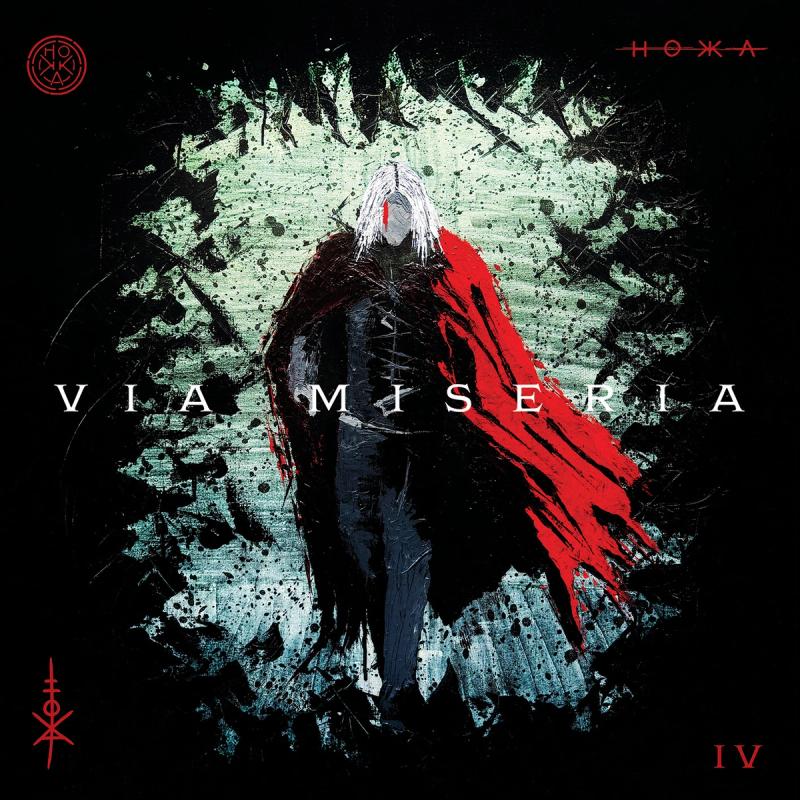
Artist
HOKKA
Release Date
April 24, 2026
Label
Nuclear Blast Records
Type
Via Miseria IV
From the very first moments of Via Miseria IV, there’s a distinct sense that this isn’t an album built for passive listening. Hokka lean fully into immersion here, crafting a record that feels heavy not just in sound, but in intent. It carries a kind of emotional gravity that builds slowly and deliberately, pulling you further in the longer you stay with it. Rather than presenting obvious entry points or immediate payoffs, the album unfolds with patience, allowing its ideas to settle and evolve in a way that feels far more organic than formula driven.
What makes Via Miseria IV particularly compelling is how it handles atmosphere. The record exists in this constant state of tension, never quite erupting into chaos but never settling into comfort either. The guitars play a huge role in this, often sitting in that space between melody and abrasion. There’s a grit to their tone that feels worn in rather than artificially aggressive, giving the music a sense of authenticity that’s hard to replicate. Layers build gradually, sometimes so subtly that you don’t immediately notice the shift until you’re already deep within it, and that attention to detail is what keeps the album engaging across its full runtime.
The rhythm section deserves just as much credit for how the album moves. There’s a deliberate restraint in how everything is constructed, nothing feels rushed or overplayed. The drums, in particular don’t dominate the mix but instead guide it, locking everything into a steady pulse that allows the rest of the instrumentation to breathe. Basslines sit low but present, adding depth rather than flash, reinforcing that underlying sense of weight that defines the album’s core. It’s this collective discipline that gives the record its cohesion, every element feels like it’s working towards the same emotional outcome rather than competing for attention.
Vocally, the album takes an approach that prioritises feeling above all else. There’s a raw, almost unfiltered quality to the delivery that makes it feel immediate and personal. It never comes across as overproduced or overly refined instead, it leans into its imperfections and that’s exactly what makes it believable. There’s a push and pull between vulnerability and intensity throughout, with quieter passages carrying just as much emotional weight as the heavier ones. It’s the kind of performance that doesn’t just sit on top of the instrumentation but becomes part of the atmosphere itself.
One of the strongest aspects of Via Miseria IV is its pacing. In a genre where it’s easy to fall into the trap of constant escalation, this album does the opposite. It understands the value of space. Moments of restraint are given time to breathe, allowing tension to build naturally rather than being forced. When the album does shift into heavier territory, it feels earned, not expected. That dynamic control is what keeps the listening experience engaging from start to finish, it never feels predictable, even when the overall tone remains consistent.
The production plays a subtle but crucial role in all of this. It strikes a careful balance between clarity and atmosphere, ensuring that every layer can be felt without losing the rough edges that give the music its character. There’s a slight haze over everything, almost like the sound is being filtered through the emotional lens of the album itself. It adds to that sense of immersion, making the record feel cohesive rather than pieced together. Nothing feels overly polished, and that restraint allows the natural textures of the instrumentation to come through in a way that feels honest.
Lyrically and thematically, even without focusing on specific lines, there’s a clear sense of introspection running throughout the album. It feels reflective, almost confrontational at times, as though it’s exploring internal struggles rather than external narratives. That inward focus gives the record a sense of intimacy that matches its sonic weight. It’s not trying to tell you what to feel, it simply presents its emotions in a way that invites you to connect with them on your own terms.
Another thing that becomes more apparent with repeated listens is how interconnected everything feels. Transitions between sections are handled with care, often blurring the lines between where one idea ends and another begins. This gives the album a fluidity that reinforces the idea of it being a complete body of work rather than a sequence of separate tracks. It’s easy to lose track of time while listening, which speaks to how effectively it holds your attention without relying on obvious standout moments.
As the album moves toward its closing stretch, there’s no dramatic shift in direction or sudden attempt to summarise everything that came before. Instead, it maintains its tone, allowing the atmosphere it’s built to linger. The ending doesn’t feel like a conclusion as much as it feels like a continuation, like the emotional weight of the album extends beyond its runtime. That lingering effect is one of its biggest strengths, it stays with you, subtly, long after it’s finished.
In the context of Hokka’s output, Via Miseria IV feels like a fully realised vision. It doesn’t rely on trends or obvious genre tropes to carry it, it succeeds because of its commitment to mood, pacing, and authenticity. It’s not an album designed for instant gratification and it doesn’t need to be. Instead, it offers something far more lasting, a deeply immersive experience that reveals new layers with each listen and rewards those willing to give it their full attention.
Ultimately, Via Miseria IV stands as a record that values depth over immediacy, atmosphere over spectacle, and emotion over perfection. It’s a slow burn in the truest sense, one that might not hit all at once but once it settles in, it’s hard to shake.