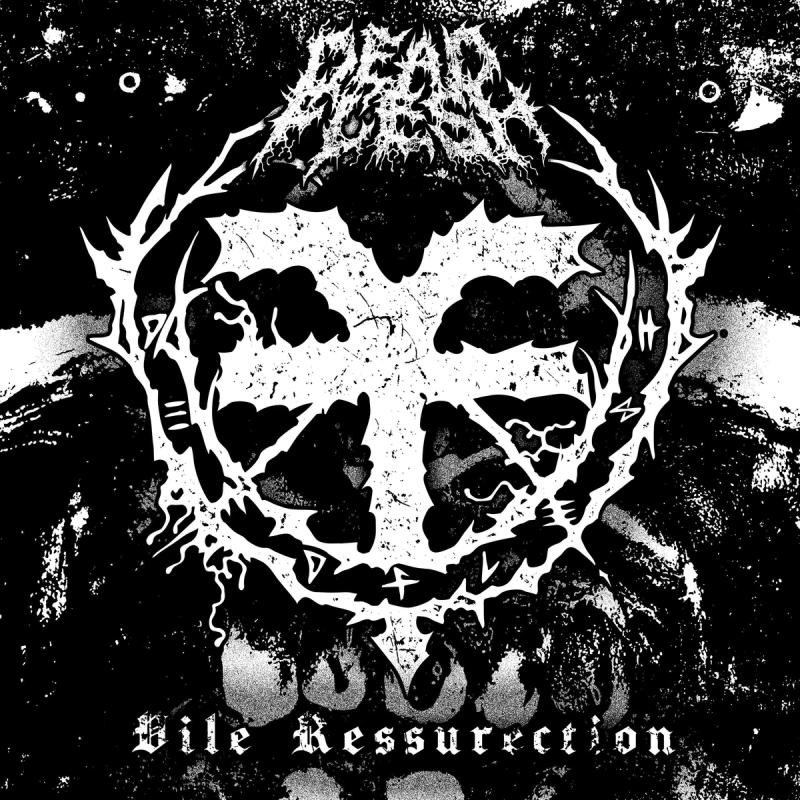
Artist
Dead Flesh
Release Date
June 24, 2026
Type
SINGLEVile Resurrection
There’s a particular kind of modern deathcore that doesn’t just aim to sound heavy, but instead tries to feel suffocating, like it’s actively collapsing in on itself with every passing second. Dead Flesh have been circling that space for a while now, but Vile Ressurection feels like the moment everything they’ve been building towards finally snaps into place.
From the outset, the track leans straight into controlled chaos. It doesn’t bother easing the listener in or building atmosphere through restraint instead, it arrives fully formed, already drenched in distortion and aggression. The opening moments set a tone that is less about introduction and more about impact with riffs that feel sharpened rather than simply played. There’s a deliberate sense of hostility in the way the instrumentation is constructed, not random noise but something tightly wound and waiting to detonate.
The guitar work sits at the centre of that tension. Rather than relying on constant speed or endless chugging, the riffs shift between dense rhythmic punishment and more dissonant, uneasy phrasing that keeps the track unstable. It’s not a comfortable listen in any sense, and that’s exactly the point. Even when the groove locks in, there’s a persistent unease underneath it, like the structure could collapse at any second.
What stands out most is how Vile Ressurection handles momentum. A lot of modern extreme metal tends to flatten itself through repetition or overuse of breakdown driven pacing, but Dead Flesh resist that urge here. Instead, the track feels like it’s constantly rotating through different states of aggression. Sections bleed into each other rather than resetting, which gives the song a more fluid and more disorienting identity. It’s less a collection of parts and more a single, continuous escalation.
The rhythm section deserves just as much attention. The drums don’t just support the guitars, they actively push against them. Blast driven passages feel almost unstable in their execution, while the heavier half time sections hit with a deliberate, dragging weight that contrasts sharply with the faster moments. That contrast is where the track finds most of its impact. It’s not just about speed or heaviness individually but the way those two extremes are used to destabilise the listener’s sense of timing.
Vocally, the performance is delivered with a kind of unrelenting force that feels less like expression and more like rupture. There’s a layered quality to the delivery, gutturals that sit deep in the mix, higher screams that cut through the top end, and mid range aggression that ties everything together. Rather than relying on clean separation between styles, the vocals often blur into one another, creating a wall of sound that feels intentionally overwhelming. It doesn’t aim for clarity, it aims for pressure.
Lyrically, the track leans into themes of corruption, decay, and return not in a literal sense of resurrection but more as a twisted reinterpretation of it. The idea feels less like revival and more like something that should have stayed buried forcing its way back into existence. There’s a strong sense of imbalance running through the concept, as though whatever is being resurrected has come back wrong, incomplete or fundamentally altered. That concept fits neatly into the sonic identity of the track, where nothing ever feels entirely stable or resolved.
One of the more effective elements of Vile Ressurection is its pacing. Even when the track hits its heaviest points, there’s a sense that it’s still moving forward rather than simply stopping to punish the listener with breakdowns. The heavier sections feel earned rather than inserted, arriving as natural consequences of the surrounding chaos rather than isolated moments. That gives the song a stronger sense of direction than many of its contemporaries in the genre.
There’s also a subtle but important sense of atmosphere woven into the track. It’s not atmospheric in the traditional sense, there are no sprawling ambient passages or overt melodic sections but instead through texture. The production itself creates a kind of claustrophobic space where everything feels slightly too close, slightly too compressed, as if the track is being played inside a tightening enclosure. That production choice reinforces the emotional weight of the song without ever drawing attention away from the core aggression.
By the time Vile Ressurection reaches its conclusion, it doesn’t feel like it resolves so much as it simply stops. That lack of clean resolution works in its favour. There’s no sense of relief, no easing out of tension, just an abrupt ending that leaves the energy hanging in the air. It suits the overall identity of the track, which feels more like an experience to endure than a narrative to follow.
Ultimately, Dead Flesh has delivered a single that thrives on intensity but avoids the common pitfall of becoming one dimensional. It’s aggressive throughout but not predictable. Dense, but not directionless. The result is a track that feels deliberately uncomfortable in a way that’s difficult to ignore, and that alone gives it a strong identity within the modern deathcore landscape.
If Vile Ressurection is any indication of where Dead Flesh are heading next, it suggests a band less interested in refinement for its own sake and more focused on pushing their sound into increasingly unstable territory and doing it with intent.